
What to Look for in a Retail Fragrance Manufacturing Partner
 EMAIL
EMAIL COPY LINK
 TWITTER
 LINKEDIN
 FACEBOOK
Why the Right Manufacturing Partner Matters
Selecting a fragrance manufacturing partner is more than a procurement decision. It is a decision that directly affects product quality, speed to market, and long-term scalability.
Analysis from Boston Consulting Group notes that supplier partnerships frequently underperform due to misalignment in expectations, execution, operational visibility, and long-term strategic priorities. While those failures are often discussed in broader procurement terms, the consequences are amplified in beauty and fragrance manufacturing, where formulation, packaging, and filling systems must operate together without interruption.
That pressure is increasing as more beauty brands rely on outsourced manufacturing. Mordor Intelligence estimates the personal care contract manufacturing market will grow from $27.01 billion in 2026 to $40.09 billion by 2031, reflecting continued demand for external manufacturing and production partners.
$40.09 billion by 2031
The size of the personal care contract manufacturing market according to Mordor Intelligence
In fragrance manufacturing, failed partnerships often surface late in the process, when they are most expensive to fix. Delays tied to filling variability, packaging incompatibility, production scheduling, or quality issues can affect launch timelines, retail commitments, and long-term brand performance.
Many of these issues emerge in the period between formula approval and commercial production, when timelines tighten and operational coordination becomes critical.
The Capabilities That Actually Matter at Scale
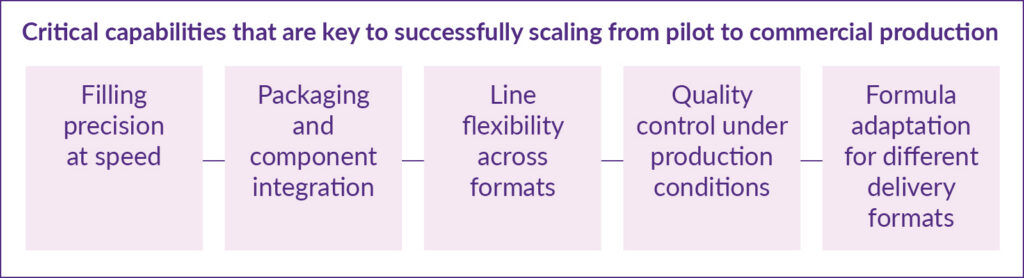
Not all manufacturing capabilities carry equal weight. At scale, a narrower set of operational capabilities determines whether a product can be produced consistently. The transition from pilot production to commercial scale is often where operational weaknesses become visible.
The most critical include:
- Filling precision at speed: Maintaining consistent fill volumes across large runs without introducing variability
- Packaging and component integration: Ensuring compatibility between bottles, pumps, sprayers, and formulations
- Line flexibility across formats: Supporting vials, travel sprays, and full-size products without reengineering production workflows
- Quality control under production conditions: Maintaining consistency while operating at high throughput
- Formula adaptation for different delivery formats: Adjusting viscosity, slurry composition, evaporation profile, or substrate compatibility for applications such as scent strips, vials, sprays, and other sampling formats
As fragrance production scales globally, manufacturers are also under increasing pressure to balance speed, flexibility, formulation adaptability, and precision across multiple markets and formats.
EU vs North America: What Actually Changes
Working with manufacturing partners across regions introduces additional complexity.
In North America, production timelines tend to move faster, with greater emphasis placed on speed to market. In the European Union, manufacturing environments typically prioritize validation, documentation, and process rigor earlier in the production cycle.
This affects:
- production timelines
- packaging validation requirements
- testing expectations
- operational flexibility during launch windows
Manufacturing investment trends reflect the continued importance of Europe within global beauty production. Reporting from Le Monde highlights ongoing cosmetics manufacturing expansion in France despite broader market slowdowns, reinforcing Europe’s position as a critical production hub for fragrance and beauty brands.
For brands operating globally, these differences require coordination across regions rather than treating manufacturing as a single workflow.
Why Integration Matters
Fragrance manufacturing does not operate in isolated steps. It is a connected system.
When formulation, packaging, and filling are managed separately, the likelihood of delays and variability increases. As beauty launches accelerate, brands are placing greater emphasis on operational control and manufacturing coordination.
Just as important is operational alignment between teams. In manufacturing partnerships, communication style, responsiveness, escalation processes, and day-to-day collaboration often become early indicators of whether a relationship will function effectively under production pressure. A partner may appear technically capable on paper but still create friction if expectations, decision-making, and communication practices are misaligned.
The industry is increasingly prioritizing tighter operational coordination as fragrance businesses scale globally. Beauty brands like Dolce & Gabbana are investing more heavily in integrated operational strategies as fragrance and beauty businesses become larger and more strategically important. “Working with subcontractors is still a much faster process than licensees,” says Alfonso Dolce.
Arcade Beauty’s model reflects this shift, combining fragrance blending, filling, and packaging development into a coordinated workflow designed to support both sampling formats and full-scale retail production.
Learn how Arcade Beauty expands beyond sampling to turnkey manufacturing