
Small-Batch to Scale: A Guide to Pilot Runs, Short Runs, and Commercial Launch in Beauty
 EMAIL
EMAIL COPY LINK
 TWITTER
 LINKEDIN
 FACEBOOK
What Is a Pilot Run in Cosmetic Manufacturing?
A pilot run is a small-scale production run conducted under near-commercial conditions to validate how a formulation, packaging format, and process perform together before full-scale manufacturing.
It is the first point where a product is exposed to real production constraints. Lab batches confirm that a formula works. Pilot runs determine whether it can be manufactured consistently, filled at speed, and packaged without failure. This is the transition from development to commercialization.
For beauty brands, that transition matters because launch success depends on more than formulation. It depends on whether the product can move from trial, sampling, short run manufacturing, and commercial production without being redesigned at each stage.
Small Batch Cosmetics Manufacturing vs. Pilot Run vs. Short Run Manufacturing
Small batch cosmetics manufacturing is often treated as proof of readiness. It is not.
Small batch work typically supports formulation and iteration. It does not fully replicate production equipment, supply chain variability, or throughput conditions. Pilot run manufacturing introduces those constraints for the first time. Short run manufacturing produces market-ready units at limited volumes, often for launches, discovery sets, travel formats, or channel testing. Commercial production prioritizes repeatability, cost control, and scale.
The gap between small batch and scalable production is where most issues surface.
Why Sampling and Scaling Beauty Manufacturing Is Changing
Beauty products increasingly move through a more complex commercial path. Discovery, sampling, minis, refills, e-commerce kits, travel formats, and full-size retail formats are now part of the same brand experience. That creates new pressure on manufacturers.
Arcade Beauty’s heritage gives this article a more specific point of view. The company is not approaching scale only from the perspective of bulk production. Its position has expanded from sampling into turnkey fragrance and cosmetic manufacturing, including blending, filling, assembly, packaging, and retail-ready formats.
That matters because sampling is no longer a separate marketing exercise. In many beauty categories, it is the first manufacturing expression of the product. If a formula, fill format, package, or supply chain cannot support the move from discovery to purchase, the brand risks delay before it ever reaches full commercial scale.
Read More: Arcade Beauty Expands Beyond Sampling to Lead Turnkey Fragrance and Cosmetic Manufacturing
What Actually Changes When You Scale Cosmetic Production
Scaling is not a linear increase in volume. It changes how the system behaves.
- Heat transfer becomes uneven, affecting emulsion stability
- Mixing dynamics shift, altering texture and consistency
- Fill performance tightens as speed increases
- Exposure risk increases across handling and packaging
The FDA notes that cosmetic products are susceptible to contamination during manufacturing, particularly when processes are not tightly controlled.
For Arcade Beauty, this is where format expertise becomes important. A fragrance vial, packette, sachet, 3D pouch, mini mascara, jar, tube, or full-size bottle does not behave the same way in production. Each format creates different requirements for filling, sealing, assembly, handling, and quality control.
Arcade’s manufacturing capabilities show that this format range spans fragrance, skincare, hair care, and color cosmetics, each with different production constraints.
The One Decision That Determines Whether a Product Can Scale
Manufacturability is largely determined before production begins. Formulation, packaging, and process cannot be separated.
A product designed without regard for production constraints will require correction later, often at significant cost. Under the FDA’s MoCRA framework, manufacturers must register facilities, list products, and maintain safety substantiation.
Scaling is accountable, traceable, and subject to oversight.
The earlier a brand aligns its formula, package, and manufacturing pathway, the easier it becomes to move from small batch to pilot run, then into short run manufacturing and commercial production. This is especially important for brands moving between samples, minis, discovery sets, and full-size retail formats.
Arcade Beauty’s turnkey cosmetic manufacturing capabilities connect bulk manufacturing, packaging solutions, and filling and assembly across samples, multi-use formats, and full-size products.
Why Pilot Runs Fail to Scale
Most failures are predictable. They occur when pilot runs are treated as a checkpoint rather than a stress test.
- Formulas behave differently under production conditions
- Packaging fails at speed or under pressure
- Equipment cannot support the intended format
- Supplier variability introduces inconsistency
Pilot runs are effective only when they are designed to expose these issues under realistic conditions.
For brands, the risk is not simply a delayed batch. It is a delayed launch, missed retail window, packaging rework, or the need to revalidate decisions that should have been resolved earlier.
Cosmetic Manufacturing Equipment as a Constraint
Equipment determines what is possible at scale. Lab environments allow flexibility. Production environments do not.
Mixing vessels, heating systems, filling lines, sealing systems, glass vial production, laminate conversion, and assembly equipment all operate within defined limits. Automation improves efficiency but reduces tolerance for variability. A formulation that performs well in development can fail when exposed to production equipment.
Arcade Beauty’s filling and assembly services support formats ranging from mono-dose samples and mini products to full-size formats. Its packaging capabilities include vertically integrated paper, laminate, and glass vial manufacturing, which helps reduce handoffs between packaging development and production.
This is where Arcade’s position becomes distinct. The company’s role is not limited to making more units. It helps align the product format, packaging system, and manufacturing route before scale exposes weaknesses.
Scaling Manufacturing in Europe vs North America
Scaling across regions introduces regulatory and operational differences.
In the United States, cosmetics operate under a post-market framework. Responsibility for safety rests with the manufacturer. The FDA’s facility registration and product listing requirements formalize that responsibility.
In the European Union, requirements are more stringent before market entry. The European Commission framework requires documented safety assessments and product information files prior to commercialization.
A product that scales in one region may require rework in another. This affects timelines, cost, documentation, sourcing, packaging claims, and manufacturing strategy.
Arcade Beauty’s global footprint gives this section a stronger point of view. The company has manufacturing and commercial presence across North America, South America, Europe, and Asia, with capabilities spanning fragrance blending, bulk manufacturing, packaging, filling, and assembly.
3 Criteria That Define Whether a Product Is Ready to Scale
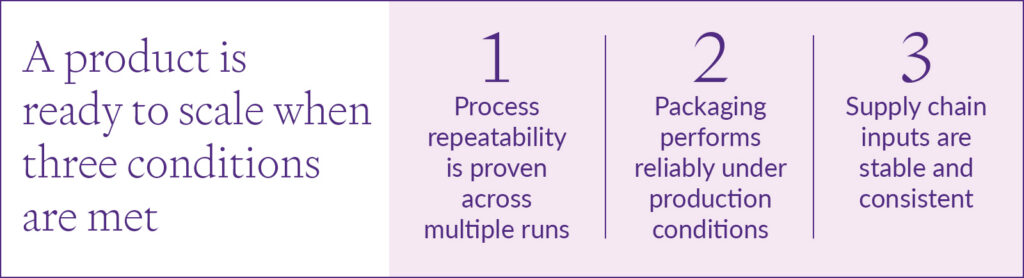
These principles align with ISO 22716 guidance, which emphasizes process control, traceability, and quality management in cosmetic manufacturing.
The practical test is simple: can the same product be manufactured consistently across the intended format, volume, market, and regulatory environment? If not, the product is not truly ready to scale.
Why Turnkey Contract Manufacturing for Beauty Products is in Demand
As scaling complexity increases, brands are moving toward integrated manufacturing models.
According to Beauty Packaging there is growing demand for turnkey solutions that combine formulation, packaging, and production into a single workflow.
This shift is driven by practical constraints: faster time-to-market expectations, increasing regulatory requirements, and the need to reduce risk between pilot and production.
Arcade Beauty’s own evolution reflects this market shift. Its turnkey model connects sampling, fragrance blending, bulk manufacturing, packaging, filling, and assembly into a broader formula-to-shelf capability. That is particularly relevant for brands moving across discovery formats, cosmetic minis, travel products, refill concepts, and full-size retail production.
Choosing a Beauty Products Contract Manufacturing Partner
At scale, the role of a manufacturer changes from execution to coordination.
Choosing the right partner ensures alignment between formulation, packaging, and production from the beginning. It supports pilot runs, short run manufacturing, and commercial production without introducing disconnects between stages.
For beauty brands, this is especially important because product formats are multiplying. A launch may involve sample formats, discovery sets, e-commerce kits, retail minis, refill pouches, and full-size packaging. Each format has to support the same brand promise while meeting different manufacturing requirements.
That is why integration matters. Fragmentation slows scale. A coordinated manufacturing model reduces handoffs, improves control, and helps brands move from small batch to launch with fewer surprises.
For brands evaluating beauty products contract manufacturing partners, Arcade Beauty’s value is clearest where sampling, packaging, formulation, and production intersect: explore Arcade Beauty’s full-service manufacturing capabilities.
Bottom Line
Scaling a beauty product is not a matter of increasing output. It is a transition from formulation to system.
Small batch success does not validate manufacturability. Pilot runs do. Process design determines whether scale is efficient or expensive.
As regulatory pressure increases and timelines compress, brands are shifting toward integrated manufacturing models that reduce risk across the entire lifecycle. That shift explains the growing demand for turnkey solutions and why Arcade Beauty’s expansion beyond sampling is commercially important.
In beauty manufacturing, products do not only compete on formulation. They compete on whether the entire system can scale.