
What ‘Turnkey’ Means in Beauty Manufacturing (And Why It Matters for Brands Scaling Fast)
 EMAIL
EMAIL COPY LINK
 TWITTER
 LINKEDIN
 FACEBOOK
What Is Turnkey Beauty Manufacturing?
In beauty manufacturing, “turnkey” refers to a fully integrated production model where a single partner manages the entire process—from formulation and testing to packaging, filling, and assembly.
Rather than coordinating multiple vendors across development, sourcing, and production, brands work with one manufacturer that delivers a ready-for-market product.
For emerging and established brands alike, the appeal is straightforward: fewer handoffs, faster timelines, and tighter control over quality.
What Does a Turnkey Partner Actually Handle?
A true turnkey manufacturer goes beyond contract filling or packaging. The model typically spans:
- Formulation development (custom or stock base adaptation)
- Ingredient sourcing and compliance
- Stability and compatibility testing
- Packaging engineering and component sourcing
- Filling, assembly, and finishing
- Quality assurance and regulatory alignment
- Artwork adaptation, pre-press preparation, and print production coordination
This integrated approach reduces fragmentation—a persistent issue in traditional beauty supply chains, where formulation labs, packaging vendors, pre-press teams, and contract manufacturers often operate in silos, creating unnecessary delays and revision cycles.
For brands navigating regulatory expectations, resources like the U.S. Food & Drug Administration’s cosmetics guidance outline the compliance landscape that turnkey partners help manage.
Why Brands Are Moving Toward Turnkey Models
The shift toward turnkey manufacturing reflects broader pressure on beauty brands to move faster without sacrificing quality.
Three forces are driving adoption and integrating operations efficiently at a global scale is a natural extension of all three.
01
Speed to Market
Launching a product through multiple vendors introduces delays at every transition point. Turnkey partners compress timelines by running processes in parallel, not sequence.
02
Operational Simplicity
Managing five vendors means managing five timelines, contracts, and risk profiles. A turnkey model consolidates accountability under one roof.
03
Scalability Without Reinvention
As brands grow, fragmented supply chains often break. Turnkey partners are structured to scale production without requiring brands to rebuild their vendor network.
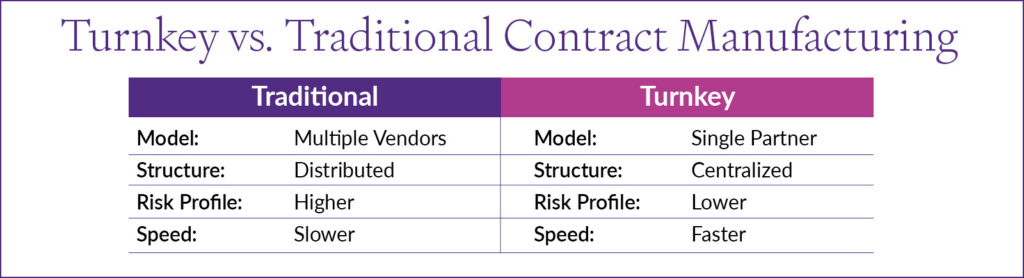
Turnkey vs. Traditional Contract Manufacturing
The distinction is less about capability and more about integration.
Traditional models can still work well for brands with internal expertise and established supplier networks. But for brands prioritizing speed, turnkey reduces coordination friction—often the hidden cost in product development.
Where Turnkey Models Deliver the Most Value
Turnkey manufacturing is not universally necessary. It is most valuable in scenarios where complexity and speed intersect:
- New product launches with tight timelines
- New bands entering that lack category-specific information (e.g., skincare to fragrance)
- Retail-driven deadlines requiring synchronized execution
- Sampling and trial formats tied to marketing campaigns
For example, integrated sampling programs—where formulation, packaging innovation, and fulfillment intersect—benefit significantly from a unified production approach rather than segmented vendors. Ensuring all of this gets done efficiently and sustainably is a unique opportunity when partnering with a turnkey manufacturer.
Continue Reading: What to Look for in a Retail Fragrance Manufacturing Partner
The Hidden Risk of “Partial Turnkey”
Not all turnkey claims are equal.
Some manufacturers position themselves as turnkey providers while outsourcing critical stages such as formulation or packaging engineering. This creates a hybrid model that reintroduces the very coordination challenges turnkey is meant to eliminate.
Brands evaluating partners should look for:
- In-house formulation capabilities
- Direct control over packaging development
- Integrated quality and testing processes
- Clear accountability across the full lifecycle
How Turnkey Manufacturing Supports Modern Beauty Innovation
The beauty industry is evolving toward faster iteration cycles, sustainability requirements, and omnichannel distribution. These trends favor partners that can connect development, packaging, and production into a single workflow.
According to industry analysis from sources like McKinsey’s beauty insights, brands that streamline product development pipelines are better positioned to respond to shifting consumer demand.
Turnkey manufacturing aligns directly with that shift—enabling brands to test, launch, and scale without operational drag.
Where a Strategic Partner Makes the Difference
Turnkey manufacturing is not simply about consolidation. At its best, it functions as an extension of a brand’s product development and operations team.
That distinction matters.
Because in practice, the difference between a vendor and a partner is not capability—it is how seamlessly those capabilities are connected.